The New Jerusalem Calendar Act
Model Legislative Framework
⸻
Section 101. Purpose and Findings
(a) Purpose.
The purpose of this Act is to present a modeled civil calendar reform designed to restore order, predictability, and consistency to global timekeeping for business, education, governance, and family life.
(b) Findings.
The drafters of this Act find that:
1. Modern civil calendar usage developed through a series of historical reforms, including:
(A) an extraordinary transition year of 445 days in 46 BC enacted under Roman authority to realign the seasons, which established the Julian calendar;
(B) a subsequent civil correction in 1582 AD, implemented in parts of continental Europe, which introduced the Gregorian calendar to address accumulated solar drift;
and
(C) a later adjustment in 1752 AD, when England and its American colonies adopted the Gregorian calendar through statutory calendar realignment.
(D) The recurrence of calendar corrections across centuries demonstrates that widely adopted civil calendar systems have required periodic structural adjustments to maintain consistency with the solar year and seasonal cycles, indicating a public interest in a stable, perpetual calendar framework that minimizes the need for future corrections while supporting long-term civil, educational, economic, and cultural continuity.
2. Historical precedent demonstrates that calendar reform has been implemented through temporary transition years rather than abrupt or disruptive change.
3. Modern global commerce, education, and technology would materially benefit from a stable, perpetual calendar structure with uninterrupted weekly cycles.
4. A carefully modeled transition year allows societies to adjust administratively while preserving legal and economic continuity.
⸻
Section 102. Proposed Transition Year
(a) Establishment of a Transition Year Model.
This Act proposes a single, voluntary transition year model consisting of 444 days, designed to facilitate conversion from the Gregorian calendar system to the New Jerusalem Calendar system.
(b) Reference Year.
For modeling and planning purposes only, the transition year is illustrated using the civil year 2032 AD.
This reference year is illustrative and non-prophetic and does not constitute a prediction, mandate, or requirement.
⸻
Section 103. Structure of the Transition Model
(a) Initial Period.
The transition year model begins using the Gregorian calendar structure in January of the reference year.
(b) Conversion Point.
Under the transition model:
• Saturday, July 24, 2032 (7/24/2032) Gregorian Calendar
shall be immediately followed by
• Sunday, July 6, 2032 (5/6/2032) New Jerusalem Calendar
(c) Continuity of the Week.
The seven-day weekly cycle shall continue uninterrupted before, during, and after the conversion point.
⸻
Section 104. Legal and Civil Continuity
(a) Validity of Acts.
All contracts, wages, obligations, records, and civil acts executed prior to or during the transition year shall remain valid and enforceable.
(b) Completion of Conversion.
Upon completion of the transition year, the New Jerusalem Calendar shall serve as the primary civil calendar system for any institution, government, or entity that adopts this Act.
The Gregorian calendar shall be retired from active civil use within such adopting bodies.
(c) Archival Reference.
The Gregorian calendar may be retained solely for historical, archival, or interpretive reference and shall not be used for ongoing civil scheduling following adoption.
(d) Voluntary Scope.
The replacement of the Gregorian calendar applies only to adopting institutions and does not bind any non-adopting party.
⸻
Section 105. Intent
The intent of this Act is to provide a peaceful, orderly, and rational pathway for calendar reform to build up the Kingdom of Heaven on Earth as per the Holy Bible should society determine such reform to be beneficial.
⸻
Attribution
Proposed by
New Jerusalem Calendar Initiative
Founder: Russell James Ewert
This Act is a proposal and a suggestion. Adoption, modification, or rejection remains the sole discretion of other governing authorities and institutions.
Visual Guide to the New Jerusalem Calendar 2032 Transition
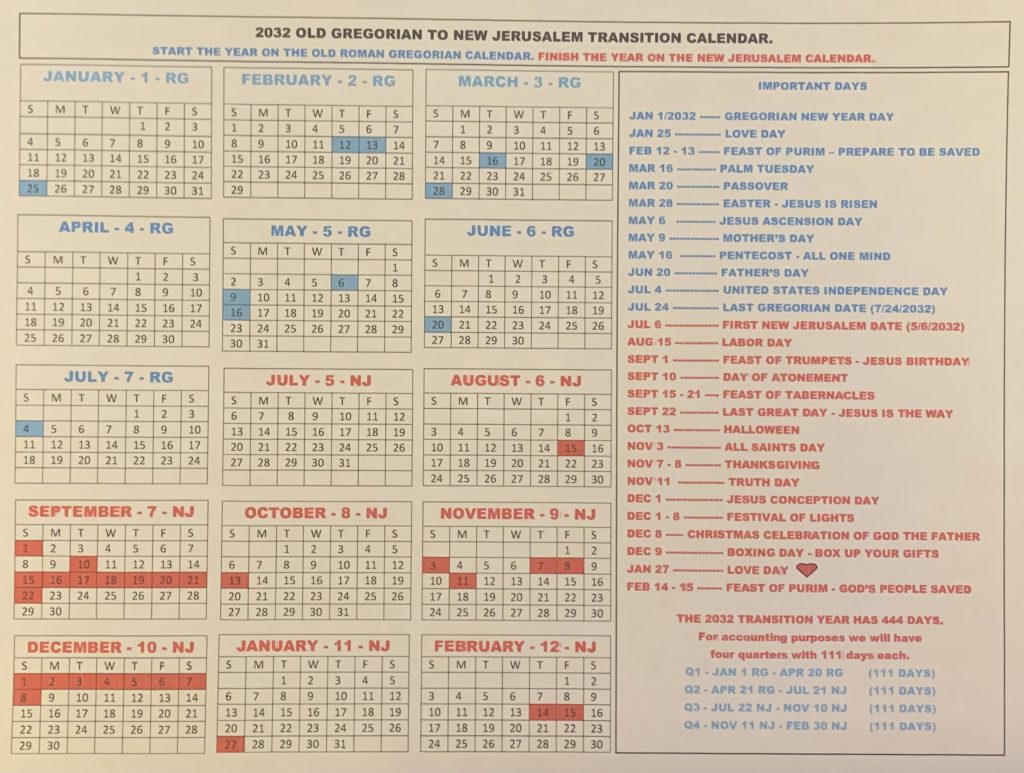
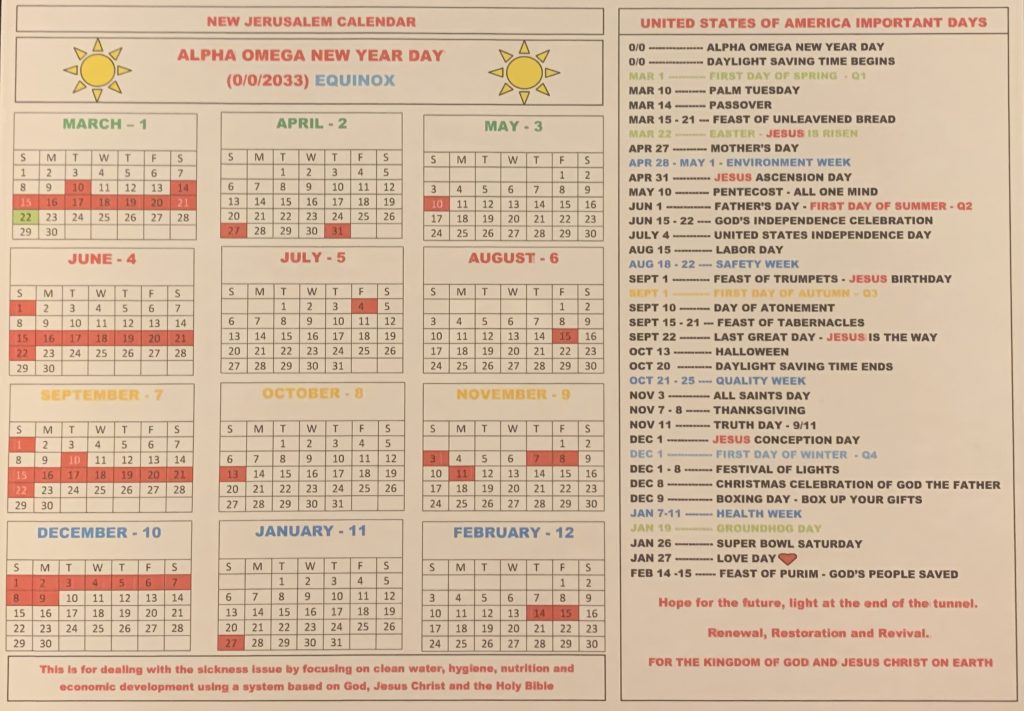
The day after Saturday, February 30, 2032 (12/30/2032) will be Alpha Omega New Year Day (0/0/2033) then Sunday, March 1, 2033 (1/1/2033).
Contact :
info@njc777.com